Make any battery, a smart battery
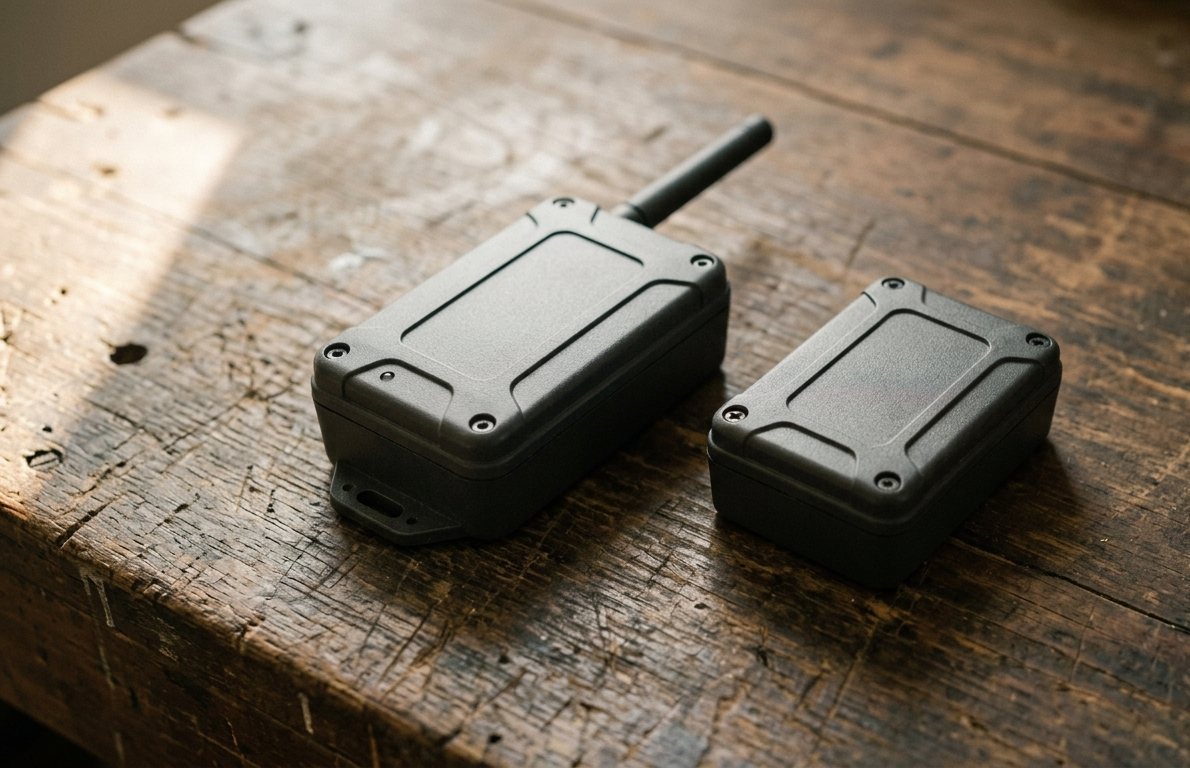
Two devices that clip onto a pack you already own. Both speak to a Bluetooth BMS and report to Chakra — one of them reads the road as well.

Your pack already knows. Nothing is listening.
Every lithium battery with a BMS is already measuring per-cell voltage, temperature, current and cycle count, several times a second. It keeps almost none of it, tells nobody, and forgets the rest. These two devices are the listener — they read what the BMS already knows over Bluetooth and carry it somewhere it can be used.
- ✓No change to the pack, the cells or the BMS
- ✓Works on batteries you already own
- ✓One fleet, one dashboard, whichever device is fitted
One reads the pack. One reads everything.
They are not a good and a better version of the same thing. Mini Gateway does the battery completely and inexpensively. Full Frame adds the sensors that make the road, the load and the driver legible — which is what the rest of our technology is built on.
Full Frame
The whole pictureThe instrumented device. It reads the battery, fixes its own position, and feels the road through a six-axis sensor — then splits what it feels into four frequency bands, which is how a pothole is told apart from a speed bump.
- ▪Every BMS field: per-cell voltages, temperatures, current, cycle count, protection and FET status
- ▪GPS with satellite count and HDOP, so a poor fix is known to be poor
- ▪Six-axis motion — three of acceleration, three of rotation
- ▪Vibration split into four frequency bands, 5–20 through 100–200 Hz
- ▪Onboard flash buffering: a journey through dead network replays when signal returns
- ▪Device health reported about itself — restarts, publish failures, stale BMS, buffer state
Mini Gateway
Fleet-wide, affordablyThe inexpensive one, and not a stripped one. Everything the BMS knows arrives at full fidelity, with position and speed beside it. What it gives up is the road-sensing hardware — so it fits the packs where the economics of the fleet, not the depth of the data, is the point.
- ▪Every BMS field the pack exposes over Bluetooth, at full fidelity
- ▪GPS and speed, so trips, routes and range are all real
- ▪Basic motion and peak vibration
- ▪Bulk upload — readings batch up and go in one call, which is what keeps it cheap to run
- ▪Confirms or contradicts what Full Frame vehicles found on the same road
- ▪Fits any pack with a Bluetooth BMS, without changing the pack
Four frequency bands, and what they unlock
A jolt is not a number. A pothole is a sharp, broad impulse; a speed bump is slow and low; a washboard stretch is periodic and sits in the middle. Measured as one figure they are indistinguishable — measured across 5–20, 20–50, 50–100 and 100–200 Hz they separate cleanly, and that separation is what everything downstream rests on.
A few instrumented vehicles, a whole fleet corroborating
You do not need Full Frame on every vehicle, and that is the point of having two. A handful of instrumented rickshaws discover what a road is like. Every Mini Gateway that crosses the same stretch afterwards either agrees or disagrees — and a disagreement is how a repaired road stops being recorded as a bad one.
The two signals are counted separately on purpose, so a confident measurement is never diluted by a cheaper one standing in for it.
Build your exact pack
Chemistry, voltage, BMS, enclosure, monitoring — each explained, with a live price and an instant WhatsApp quote.
Open the pack builder →Start with ₹0 down
Battery-as-a-Service: your old battery’s scrap value covers the deposit. ₹117/day flat, ~200 km, unlimited free recharge.
How BaaS works →